






Workgroup
Temporary grouping of professionals:
Prof. Arch. Giuseppe Cristinelli (team leader), Arch. Giordano-Bruno Cristinelli, Arch. Emma Calebich, Eng. Franco Forcellini, Eng. Carlo Kehrer, Arch. Dario Giuseppe Maso, Arch. Roberto Tommasini, Eng. Gabriele Tosi.
Description and Historical References
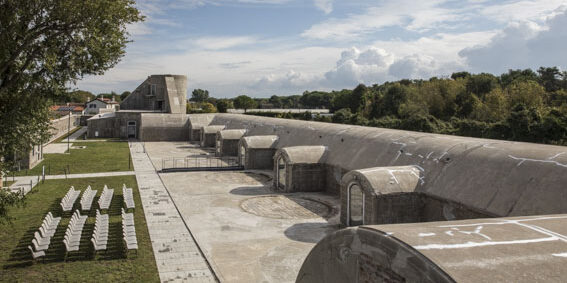
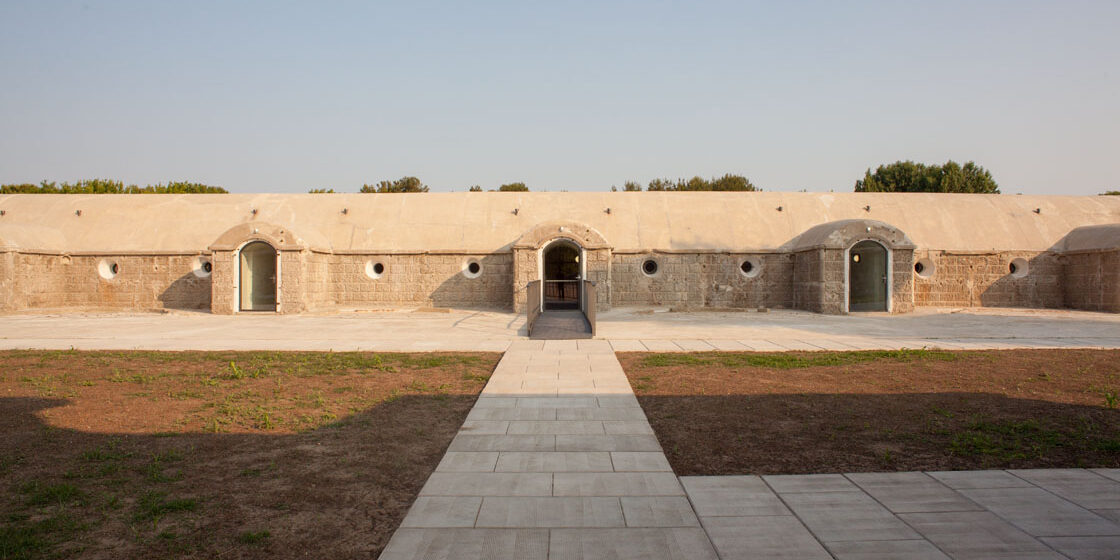
The two batteries, about 1 km apart, show different formal and distributive features due to their distinct military functions. The Pisani Battery consists of a central body, one floor above ground with a barrel vault roof, flanked by two lateral wings of equal height (4 m) with nearly flat roofs. The interior of the central body is arranged into two long galleries, connected at several points and accessible through 9 protruding sections. The lateral wings consist of smaller rooms, sometimes featuring circular niches. At the junctions between the central body and the wings, two circular towers rise to 11.5 m height, each flanked by two buttresses reachable via internal spiral staircases and external simple ramp stairs, crossing two terraces at an intermediate height (4.5 m). A tall perimeter wall encloses the courtyard where the howitzers were positioned. The Amalfi Battery is made up of a compact central body with one floor and a pseudo-circular plan, connected via underground walkways to two rectangular engine generator stations. Both batteries feature massive reinforced concrete structures, with parts in brick and stone, characterized by wall thicknesses sometimes exceeding one meter.
State of Conservation
The batteries showed deep degradation due to long abandonment, vandalism, and illegal occupation of some spaces as makeshift housing, evidenced by added constructions inside the Pisani Battery. The conservation condition of the reinforced concrete structures was particularly serious, exhibiting fractures and gaps causing water infiltration. Specifically, the barrel vault roof of the Pisani Battery was subjected to repeated thermal expansion cycles due to the lack of structural joints, causing deep through-cracks. Similar phenomena were observed in the Amalfi Battery. There was also severe degradation of all finishes (plasters, floors) and surrounding external spaces, overgrown with vegetation and litter piles found during the works.
Dimensional Extent
The staircase consists of a flight of twelve steps at the corner of Via Pontedera and Via Castelgiuncoli, a raised path parallel to Via Pontedera about 2.5 m wide and 31 m long, and another sloping walkway, roughly orthogonal to the first, a “calle” approximately 3 m wide and 17.5 m long, situated between the two buildings formerly called the Caretaker’s House (or former Gatehouse) of Villa Mugna and Palazzo Cassia Calzavara.
The intervention area covers approximately 155 sqm.
Services Provided
The covered area of the Pisani Battery is about 1800 sqm; the Amalfi Battery about 500 sqm.
The Project
The definitive project, prepared by other professionals, planned to reuse the Pisani Battery as a World War I museum, including classrooms, a bookshop, cafeteria, offices for associations, an audiovisual room, and restrooms. For the Amalfi Battery, only conservative restoration of existing structures and reorganization of the outdoor spaces was planned to make it accessible to visitors. The approach to the material restoration aimed at consolidating structures and filling large gaps without restoring the architectural elements and surfaces to their original formal completeness, thus leaving visible the results of degradation processes affecting the buildings. New internal and external finishes were designed in a contemporary language, clearly distinguishable from the existing.
The Project Variation No. 2, prepared by Prof. Arch. Giuseppe Cristinelli and other members of the Construction Management office, arose from unforeseen circumstances and new directives from the Project Manager. The variation mainly concerned the Pisani Battery in the following aspects: improving the project layout by enlarging the cafeteria and placing it directly adjacent to outdoor spaces; relocating restrooms to a more rational location to expand educational spaces; insulating and waterproofing the roof slabs; studying the best technical solutions to seal cracks on the central body’s roof; restoring usability of the right tower; improvements to the air conditioning system; and enhancements to the acoustic absorption in the audiovisual room. The variation was developed at both the definitive and executive stages.
Project Documentation
The design documents for Variation No. 2 included the definitive project: General Report and plant engineering report, bill of quantities, list of new unit prices, price analysis, comparison chart, economic framework, architectural drawings (scales 1:250 to 1:20), engineering drawings (mechanical, electrical, special and fire safety systems, scales 1:100 to 1:50), submission documents, new price agreement report, and landscape report.
Design Phase Timing
Variation No. 2 was completed in 15 days.
Construction Management
Prof. Arch. Giuseppe Cristinelli (Construction Manager, Responsible for Integration of Specialized Services), Arch. Giordano-Bruno Cristinelli (Operational Director for Architectural Works), Arch. Emma Calebich (Construction Management Consultant), Eng. Franco Forcellini (Operational Director for Structural Works), Eng. Carlo Kehrer (Construction Management Consultant), Arch. Dario Giuseppe Maso (Operational Director for Building Works), Arch. Roberto Tommasini (Safety Coordinator during execution and Site Inspector), Eng. Gabriele Tosi (Operational Director for Plant Works).
Start and Completion of Works
May 2016 – May 2017
Budget
Total estimated cost approximately €2,300,000.00
Contractor and Subcontracting
Contessa Giulio S.R.L.